Every pool you've ever swum in is doing the same thing right now: pulling water out, cleaning it, warming it, and pushing it back. Tonight we follow one drop all the way around — from a backyard pool to a hotel.
The whole idea in one picture
Out, clean, back. Forever.
Step 1 · the suction side
Two mouths, one throat.
SkimmerSits at the waterline. Grabs the floating stuff — leaves, bugs, sunscreen, that one sock.
Main drainSits on the floor. Pulls from the bottom so the deep water doesn't go stale.
Why both?Trash floats and trash sinks. Pull from only one place and half the pool never moves.
The part I care about most
Suction is strong enough to hold a person down.
A pump pulling on an open pipe can hold hundreds of pounds. In 2007 a seven-year-old girl named Virginia Graeme Baker died sitting on a broken spa drain. Her family got a federal law passed, and it changed how every pool in America is built.
Two drains, not oneIf a body covers one, the pump still breathes through the other. No vacuum lock.
Domed, tested coversEvery cover is rated and stamped. A cracked or missing cover means the pool closes. No exceptions.
The rule for youNever sit on a drain. Never pull a cover off. Long hair, loose swimsuits — keep them clear.
Step 2 · the pump
The heart.
It throws, it doesn't suckThe impeller flings water outward. That leaves an empty low-pressure spot in the middle, and the pool pushes water in to fill it. That's your "suction."
Basket firstLeaves hit the basket before the impeller. A stick in the impeller is a bad day.
It can't pull airThe pump has to be full of water — primed. Run it dry and you cook the seal in minutes.
Typical backyard pumpMoves about 40–80 gallons every minute. A bathtub every 40 seconds.
Step 3 · the filter
The kidneys.
SandCatches down to about 20–40 microns. Cheap, tough, easy. You backwash it clean.
CartridgeA giant pleated coffee filter. Around 10–20 microns. Pull it out and hose it off.
D.E.Fossil powder coating a grid. Down near 3–5 microns — the finest of the three. That's smaller than a red blood cell.
Read the gaugePressure climbing 8–10 psi above clean means it's plugged. Clean it or the flow dies.
Step 4 · the heater
Order matters here.
Heater goes after the filterNever send sand and leaves through a heat exchanger. You'd scratch it up and plug it.
Chlorine goes after the heaterStrong chlorine eats copper. Feed it upstream and you'll destroy a $4,000 heater.
It needs flow to fireA pressure switch checks that water is actually moving. No flow, no flame. That's a safety, not a bug.
Gas vs. heat pumpGas burns fuel and heats fast. A heat pump steals warmth out of the air — slower, way cheaper to run.
Step 5 · the return
Aim your eyeballs.
Eyeball fittings swivelPoint them and you steer the entire pool. Point them wrong and you get a dead corner that grows algae.
Aim slightly down and acrossYou want the whole body of water rotating, and the surface drifting toward the skimmer.
Speed limits are realUnder about 6 ft/sec on suction, 8 ft/sec on returns. Faster than that is noisy, wasteful, and hard on the pipe.
The material
Purple, blue, done.
It isn't gluePrimer melts the surface, cement melts it more, and the two pipes fuse. When it cures it's one solid piece of plastic. There's no seam to leak.
Schedule 40 white PVCBackyard pools run 1½" to 2". A hotel runs 4" or 6" — big enough to crawl through.
You get about 8 secondsOnce the cement is on, push and quarter-turn immediately. Hesitate and it sets crooked, and crooked is permanent.
Level 1 · backyard pool
Put it all together.
20,000 gallonsA normal backyard pool. The pump moves all of it through the filter in about 6 to 8 hours. That's called a turnover.
One pump does everythingSuction, filter, heat, chlorine, return. One motor, one loop.
Variable speedModern pumps slow down and run longer. Half the speed uses about an eighth of the power.
Level 2 · add a spa
Same loop. Way more muscle.
Jets need pressureA spa holds maybe 500 gallons but needs a much stronger pump than a 20,000 gallon pool. It's not about volume, it's about punch.
The blower makes bubblesThe jets shoot water. A separate air blower pushes air in to make it foam and roar.
Heat is the whole point104°F is the legal ceiling. Hotter than that is genuinely dangerous, not tougher.
Small water, fast changesLess water means chemistry swings fast. A spa needs way more attention than a pool.
Level 3 · pool and spa together
One equipment pad, two bodies of water.
Here's the trick nobody notices: the pool and the spa usually share the same pump, filter and heater. Two motorized valves swing back and forth to decide who gets the water.
Pool modeBoth valves point at the pool. Normal filtering, heater usually off.
Spa modeBoth valves swing to the spa. Now the whole system is heating 500 gallons instead of 20,000 — that's why it's hot in 20 minutes.
SpilloverSuck from the pool, return to the spa. The spa overflows into the pool and it looks like a waterfall. It's just two valves disagreeing on purpose.
Level 4 · the hotel
Same five steps. Ten times the size.
No skimmers. A gutter.The entire perimeter is the drain. Water pours over the edge all the way around, into a surge tank underground.
The surge tankWhen 40 kids cannonball in, the water has to go somewhere. The tank catches it and feeds it back when everyone gets out.
The clock is the lawHealth code sets the turnover. A commercial pool: every gallon filtered every 6 hours. A commercial spa: every 30 minutes.
Robots do the chemistryA controller tests pH and sanitizer constantly and doses automatically. A flow meter proves to the inspector it's really moving.
Real jobs · phase 1 of 3
Rough plumbing
Underground. Every pipe goes in before any concrete.
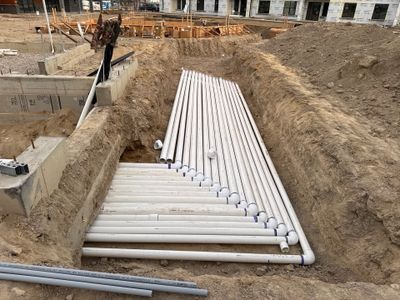
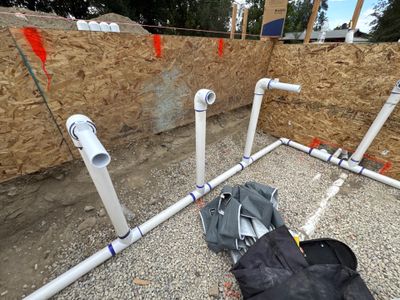
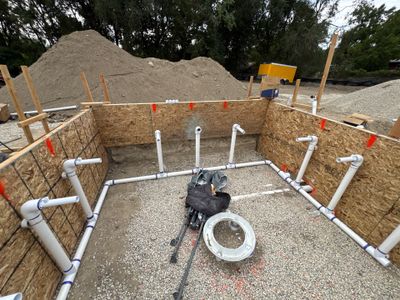
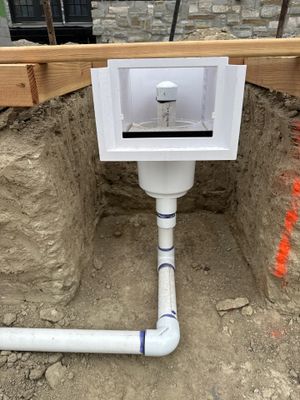
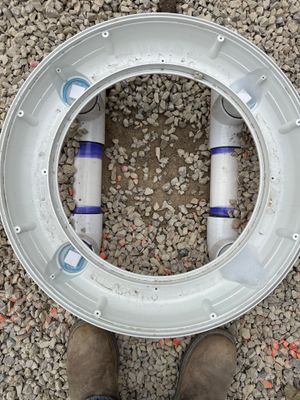
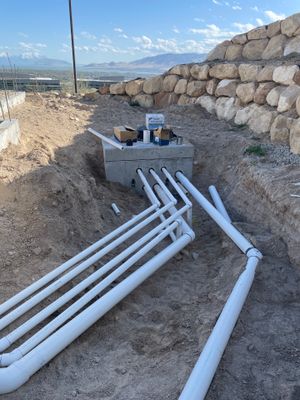
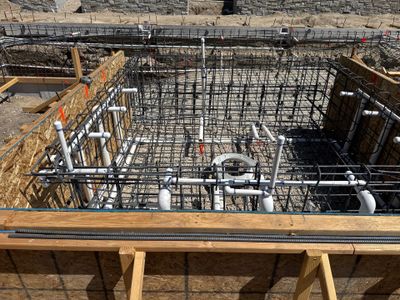
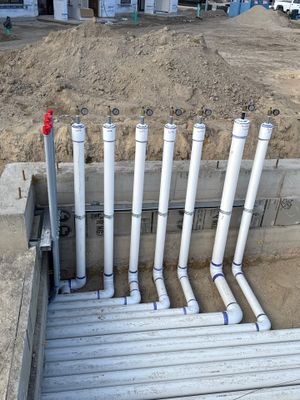
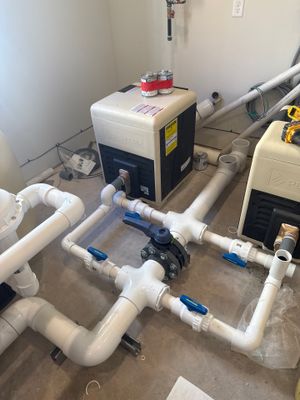
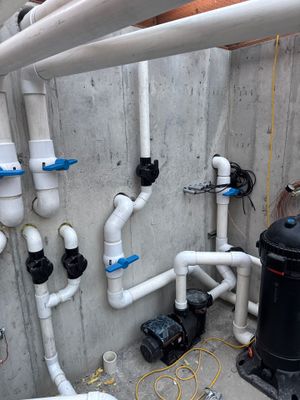
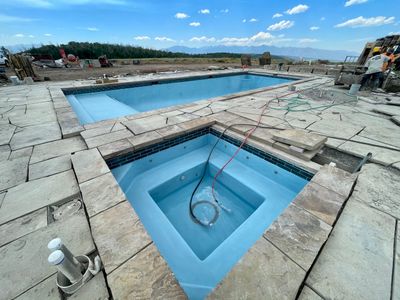
Every pipe for the pool, laid out in the trench before it goes in the groundJB3Rough plumbing assembled against the wall — glued, not screwedBonham Legacy Pool and SpaThe whole underground network before backfillBonham Legacy Pool and SpaA skimmer body set in place, its line running down and out to the pumpBonham Legacy Pool and SpaTwo main drains — pools need a pair so a swimmer can never block the suctionBonham Legacy Pool and SpaRed pipe means a special line — here it's feeding a slideClark Legacy Pool, Spa, SlideSplash pad lines — one pipe per spray nozzle, all headed out to the padPerry Splash PadSteel and plumbing together, right before the concrete goes onBonham Legacy Pool and Spa
Real jobs · phase 2 of 3
Pressure test & finish plumbing
Prove there are no leaks, then tie it into the equipment.
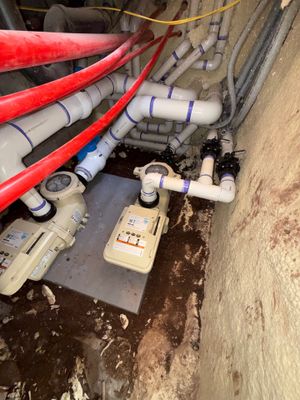
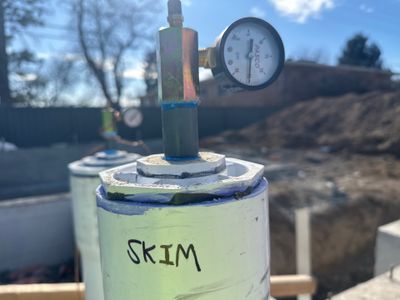
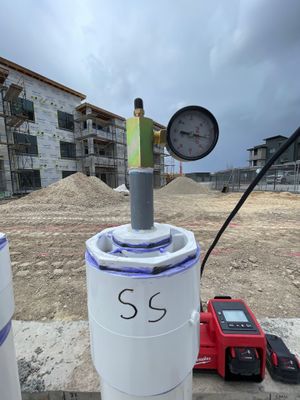
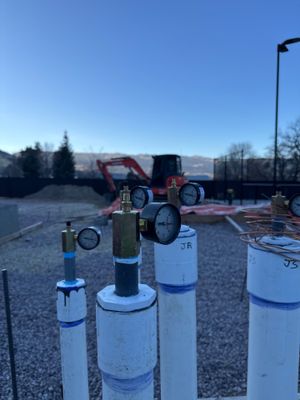
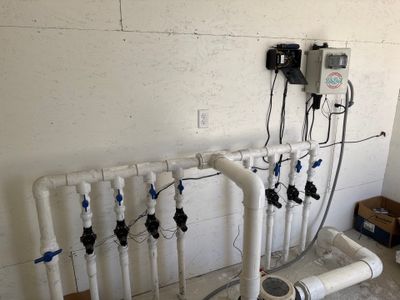
Pipe stubs standing out of the dirt — each one is a future jet, skimmer or returnJB3Every line gets labeled. This one's the skimmer, and it's holding pressureBase45Test gauge and hand pump — we fill the pipe with air and watch the needle for daysJB3A whole row of lines under test at onceBonham Legacy Pool and SpaValve manifold — the handles let you send water wherever you want itCalypsoFinish plumbing: pump, filter and heater all tied togetherKraft residential PoolThe splash pad's valve wall — each valve runs one spray featurePerry Splash Pad
Real jobs · phase 3 of 3
The finished product
All of it disappears under water and stone.
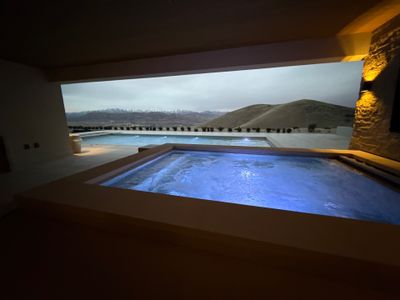
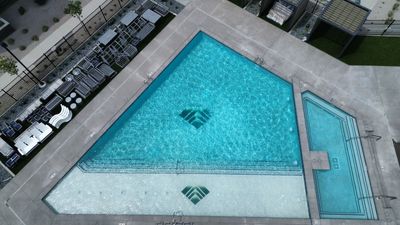
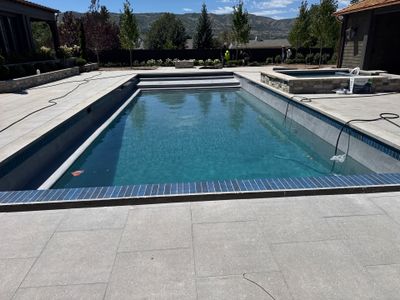
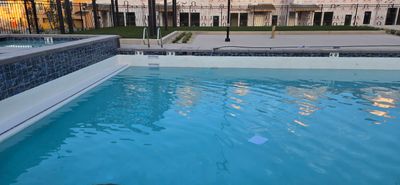
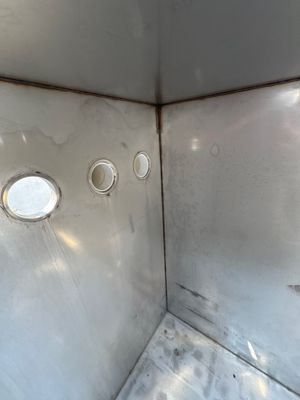
An indoor pool, finished, seen through the window at nightMike Nielson Legacy Pool and SpaSpa from above — every pipe you saw earlier is under thisWolf Creek Bison GroupJB3 from above — a finished commercial poolJB3Bonham, completeBonham Legacy Pool and SpaCalypso, finished and fullCalypsoA stainless steel pool shell — the fittings are welded inKraft residential Pool
One shot
Every pipe you just saw is buried for fifty years.
Under a foot of gravel and a slab of concrete. Nobody will ever see it again, and nobody can fix it without a jackhammer. That's the pressure of this job: you get one shot to glue it right.
You're the plumber
Five questions.
The pump is running but no water is moving. What do you check first?
The strainer basket. Nine times out of ten it's packed with leaves. After that: is the pump primed, and is a valve closed?
Why can't you put the heater before the filter?
You'd run sand, leaves and grit straight through the heat exchanger — scratching it, plugging it, and voiding the warranty. Clean the water first, then heat it.
A pool has one main drain and no skimmer. Name two problems.
One: nothing removes floating leaves and oils, so the surface goes filthy. Two: a single unblockable drain is an entrapment hazard — code requires two, at least three feet apart.
The spa heats in 20 minutes but the pool takes all day. Why?
Same heater, different amount of water. 500 gallons versus 20,000. The valves just decide which one is getting the heat.
Filter pressure has climbed 12 psi above normal. Good or bad?
Bad. The filter is loaded up and choking off flow. Backwash it or clean the cartridge. Ignore it long enough and you starve the pump and the heater.
Out, clean, back. Every pool on earth, from your neighbor's backyard to a resort in Vegas, is doing those three things right now.